Edited by Julian Cooper under the editorial policy and advertising disclosure.
AI quick summary
- True Zone 2 is easy enough to hold a conversation — most riders ride it too hard.
- It builds mitochondrial density and aerobic base; the payoff comes from consistency over months, not suffering.
- Use heart rate or perceived effort, not power alone, to keep Zone 2 honest.
/ 01
What Zone 2 actually is
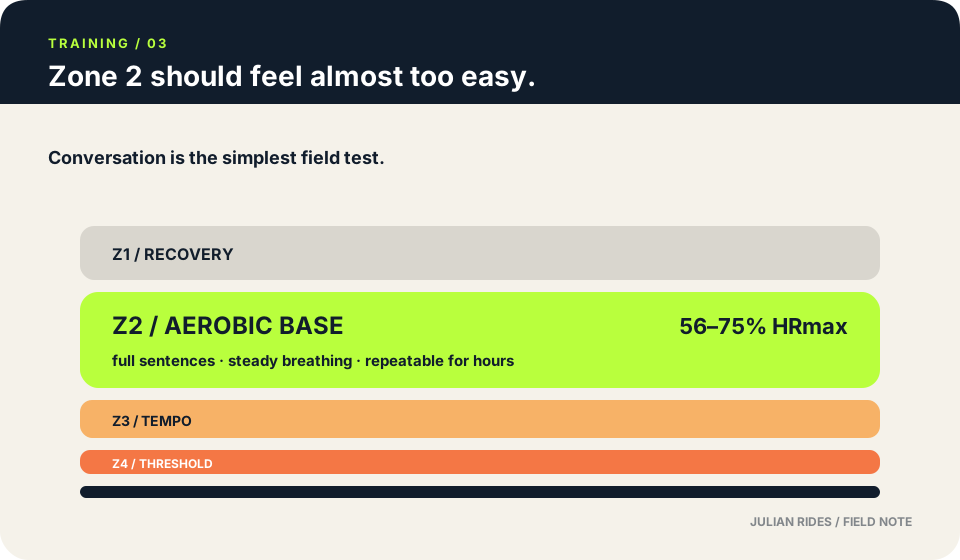
Zone 2 is a low intensity — roughly 56–75% of your max heart rate, or 55–80% of FTP in power terms — where you can still hold a conversation in full sentences. It's the zone that builds your aerobic engine without much fatigue or recovery cost.
/ 02
Why it works (the physiology, briefly)
Lots of easy time in Zone 2 increases mitochondrial density and capillary network in your slow-twitch muscle fibers, improving how efficiently you burn fat and clear lactate at higher intensities later. That efficiency raises everything else — including the pace you can hold in Zone 3 and above.
/ 03
Mistake 1: riding it too hard
The classic error. 'Easy' feels too easy, so riders drift into Zone 3 — into the no-man's-land that's too hard to recover from and too easy to spur adaptation. If you finish a Zone 2 ride feeling proud of the pace, you probably went too hard.
/ 04
Mistake 2: chasing 'pure' Z2 in traffic and hills
Real roads have stoplights, climbs, and headwinds. Don't spike above Z2 on every hill and then call it a Zone 2 ride. Flatten the route (or use a trainer), gear down on climbs, and accept that outdoor Zone 2 is approximate by design.
/ 05
Mistake 3: measuring it wrong
Power alone can mislead on a windy or tired day. Heart rate is the better Zone 2 governor because it reflects actual metabolic cost; perceived effort (can I talk?) is the simplest check of all. Use power to record, heart rate or RPE to pace.
/ 06
How much, how often
The adaptation comes from total easy time, so frequency and duration beat intensity here. Three to five hours a week of genuine Zone 2, sustained for 6–8 weeks, is where most riders feel the difference. It's unglamorous — that's exactly why it works.
/ FAQ
Quick answers
What heart rate is Zone 2 in cycling?
Roughly 56–75% of your maximum heart rate, or the intensity at which you can still hold a conversation in full sentences. It is an easy, conversational effort.
How much Zone 2 should I do each week?
Around 3–5 hours per week of genuine Zone 2, sustained for 6–8 weeks, is where most riders feel the aerobic benefit. Consistency matters more than any single ride.
Why does my Zone 2 feel so slow?
True Zone 2 should feel easy. If it feels productive, you are probably riding it too hard — most riders drift into Zone 3 because 'easy' feels too easy.
/ Sources