由 Julian Cooper 编辑,并遵循 编辑政策与广告披露。
AI 速览
- 功率为王,而非区间——每个间歇内追求最高平均功率,不维持特定区间;研究显示功率衰减会摧毁效果(如 Tabata:仅当功率保持最大值 90% 时才做 10–15 组)。
- 做不动就停,而非累了才停——当功率显著下降即结束(如 8 分钟间歇:功率跌破起始 80% 即停);硬撑疲劳适得其反。
- 休息是有目的的,而非随意——按目标匹配:求最大功率用更长休息(4 分钟),求可重复性用更短休息(2 分钟)。
/ 01
The useful question is not which interval wins
Short and long intervals are often compared as if one format must be universally superior. That framing hides the variables that actually drive the session: total hard time, power produced, recovery, and how much the rider fades from the first repetition to the last.
Dylan Johnson's video reviews studies spanning 30-second efforts to 16-minute repeats. The practical lesson is narrower than the headline: several formats work, but they create different kinds of stress. A fair comparison has to account for both intensity and total work.
/ 02
Three interval formats side by side
Starting templates, not universal prescriptions. Warm up thoroughly and scale repetitions to current fitness.
| Format | Example set | Primary demand | Best use | Main failure mode |
|---|---|---|---|---|
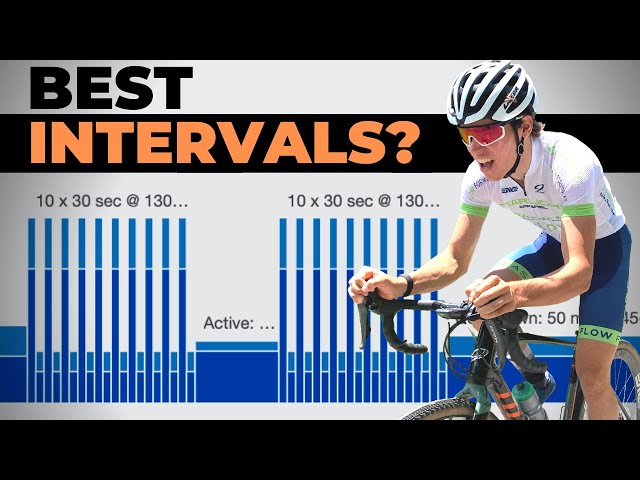
| 30/30 micro-intervals | 10–15 × 30 sec hard / 30 sec easy; 2–3 sets | Repeated high oxygen uptake | Introducing VO2 work; repeatability | Starting too hard and losing power within the set |
| 4-minute intervals | 4–8 × 4 min; about 2–4 min recovery | High aerobic power | Raising four-to-six-minute power | Treating the first rep like a time trial |
| 8-minute intervals | 4 × 8 min; about 2–4 min recovery | Sustained severe-domain work | Threshold support and durable aerobic power | Riding them as steady threshold instead of hard intervals |
/ 03
30/30s: accumulate quality without one long block
Alternating 30 seconds hard with 30 seconds easy lets breathing and oxygen consumption stay elevated while giving the legs brief relief. That makes the format useful for riders who cannot yet hold clean four-minute efforts or who need repeated surges for racing.
The easy half-minute is not a full reset. Keep pedalling, begin the next effort under control, and judge the workout by the consistency of the hard repetitions. If the last third becomes a sequence of sprints followed by near-stops, the opening pace was too ambitious.
/ 04
Four-minute intervals: high power with honest pacing
Four-minute efforts sit close to the duration many riders associate with VO2-max work. They are long enough to demand aerobic contribution and short enough to support high power. They are also easy to ruin: the first minute feels deceptively manageable, so riders frequently overreach and fade.
Use repeatable power rather than a perfect zone boundary as the control. A rider training repeatability may use roughly two minutes of recovery; a rider targeting the highest possible four-minute output may need longer. Recovery length should serve the session goal, not an arbitrary rule.
/ 05
Eight-minute intervals: more work, slightly less violence
Eight-minute repetitions lower the attainable power but extend time under heavy aerobic strain. In the research discussed in the video, four-by-eight-minute training produced a strong gain-for-effort result and was often perceived as more manageable than shorter, harder repetitions.
That does not make eight minutes magic. It makes the format a productive compromise for riders who pace well and need sustained power. The effort should remain hard enough that conversation is impossible, but controlled enough that the fourth repetition still resembles the first.
/ 06
A simple decision rule
Choose 30/30s when repeated accelerations or an accessible entry to VO2 work matters. Choose four-minute efforts when high aerobic power is the priority. Choose eight-minute efforts when you want more sustained work and can tolerate the larger total load.
Whichever format you choose, stop chasing repetitions after a clear power collapse. Extra low-quality work adds fatigue faster than adaptation. One well-paced format performed consistently is more useful than rotating workouts because the names sound scientific.
/ 07
Where HIIT belongs in a week
Hard intervals complement rather than replace easy volume and event-specific work. Riders with limited training history often improve simply by riding consistently. Better-trained riders need targeted intensity, but they also accumulate more fatigue from it.
Two hard days per week is a sensible ceiling for many amateurs. Separate them with easy riding or rest, avoid stacking them onto every group ride, and reduce the dose when sleep, illness, heat, or life stress makes normal power unusually expensive.
/ 来源