AI quick summary
- Based on your extensive research summary, here's a concise, actionable synthesis of HIIT principles for cycling—structured for immediate application while respe
- THE 3 NON-NEGOTIABLE RULES
- (From your 5 key claims, condensed to essentials)
/ 01
Summary
Based on your extensive research summary, here's a concise, actionable synthesis of HIIT principles for cycling—structured for immediate application while respecting your core philosophy of simplicity, power focus, and fatigue management. This distills the science into 3 critical rules and 3 workout templates. --- THE 3 NON-NEGOTIABLE RULES (From your 5 key claims, condensed to essentials) 1. POWER IS KING, NOT ZONES - Do: Maximize average power in each interval (no zone maintenance). - Don’t: Stay in a specific power zone—focus on output, not duration. - Why: Research shows fading (power drop) destroys results—stop when power drops 10% (e.g., Tabata: 10-15 sets only if power stays 90% of max). 2. STOP WHEN YOU’RE "DONE" (NOT WHEN YOU’RE TIRED) - Do: End intervals when power drops significantly (e.g., 8-min intervals: stop when power falls below 80% of start). - Don’t: Push through fatigue—it’s counterproductive. - Why: "More isn’t better" applies especially to power fade (Seiler’s findings). 3. REST IS PURPOSEFUL, NOT ARBITRARY - Do: Match rest periods to your goal: - Max power: Longer rest (4 mins) for single-interval peak. - Repeatability: Shorter rest (2 mins) for sustained out
/ 02
Transcript
[00:00] What are the most effective high-intensity intervals that you can do to improve your power on the bike?
[00:04] This is the question we'll be answering today by taking a look at the science.
[00:07] I'll also be discussing where to put high-intensity intervals into your training program,
[00:12] high-intensity training vs specific training,
[00:14] and at the end of the video I'll give you my top three research-based high-intensity interval workouts
[00:20] that you can use to boost your fitness.
[00:22] Welcome back to another video.
[00:31] If you're a regular viewer of this channel, you've heard me talk about how to arrange your training month and your training week.
[00:36] I've also talked specifically about threshold intervals.
[00:39] But today we're going to dive into the research on high-intensity interval training or HIIT training.
[00:44] High-intensity intervals can come in many forms,
[00:47] but are there certain types of intervals that elicit bigger fitness gains than others?
[00:51] What intensity do these intervals need to be done at?
[00:53] And how long does the rest period between intervals need to be?
[00:56] We'll get into all of that, but first let's discuss the need for high-intensity intervals in your training program.
[01:01] While there are times of the year where training should be fairly unstructured like the off-season,
[01:05] or other times of the year where you should focus mainly on high-volume zone 2 work,
[01:10] when racing is around the corner, or you just want to take your fitness to the next level,
[01:14] high-intensity intervals become important,
[01:16] and the more well-trained you are, the more important they become.
[01:20] This review article on the scientific basis for high-intensity interval training stated that
[01:24] significant improvements in endurance performance and corresponding physiological markers are evident
[01:30] following submaximal endurance training in sedentary and recreationally active groups,
[01:35] i.e. everyone from your average couch potato to your weekend warrior.
[01:39] For these people, simply getting out and riding more should be priority number one if you want to improve your fitness.
[01:45] However, additional increases in submaximal training does not appear to further enhance
[01:50] either endurance performance or associated physiological variables for athletes who are already trained.
[01:56] Improvements in endurance performance can be achieved only through high-intensity interval training.
[02:01] Essentially, there will come a point in your cycling career where you will need to include some sort of intervals,
[02:06] or high-intensity into your training program in order to improve.
[02:09] Just going out on rides isn't going to cut it.
[02:12] Breaking out into a full sprint every time a rider passes me on the bike path counts as hit training, right?
[02:18] So now that we have that out of the way, what is the most effective way to do hit work?
[02:21] I want to start by going over a study that a number of people sent me earlier this year when it was published.
[02:26] I won't name names, but some online cycling news sources wrote some sensational headlines about how short intervals are better than long intervals, citing this study.
[02:35] Here's the study in question testing short intervals versus long intervals.
[02:39] They put to the test three times 13 by 30 second intervals with 15 seconds of recovery
[02:44] versus four five-minute intervals with two and a half minutes of recovery.
[02:48] Alright, first things first, five minutes is not a long interval. Threshold intervals often go up to 20 minutes in length, but I digress.
[02:55] The results showed that the 30 second intervals resulted in a greater improvement in a 20-minute power test when compared to the five-minute intervals.
[03:02] There is one major problem with this study, though. Doing 13 by 30 second intervals three times is 19 and a half minutes of interval work,
[03:10] and doing five-minute intervals four times is 20 minutes of interval work.
[03:14] The mean power for the 30 second intervals was 441 watts, while the mean power for the five-minute intervals was just 368 watts.
[03:22] So basically, the study was comparing 19 and a half minutes done at 440 watts versus 20 minutes done at 370 watts.
[03:30] It's not surprising that the shorter intervals came out on top.
[03:33] In reality, this is not how one would typically arrange high-intensity intervals. As the interval intensity increases, the duration of the intervals and the time spent doing the intervals decreases.
[03:45] Just like when you go to the gym, the heavier the weight, the less reps you can do, when you get on the bike, the higher the intensity, the less amount of time you can do in a given session.
[03:54] Unfortunately, this study fails to take this into account.
[03:57] This study is set up similarly, but accounts for the difference in interval intensity by adjusting the time spent doing the intervals.
[04:04] They tested 12 by 30 seconds, 12 by 60 seconds, 12 by 2 minutes, 8 by 4 minutes, and 4 by 8 minutes.
[04:11] And as the interval length goes up, intensity goes down.
[04:14] This is good because they really got the full range of what most would consider high-intensity intervals, all the way from 30 seconds to 8-minute interval lengths.
[04:22] The improvements in 40k performance were greatest for the 8 by 4-minute intervals, followed closely by the 30-second intervals.
[04:30] So it looks like what really shined in this study was your typical VO2 max interval length, and then your Tabata-style intervals, where, for example, you might do a short interval of 30 seconds, followed by a short rest period of 15 to 30 seconds, repeated many times.
[04:45] And further research confirms that both these styles of intervals are very promising, potentially because of an increase in VO2 max.
[04:52] This review article on optimal training intensity for enhancing VO2 max stated that well-trained distance runners have been reported to reach a plateau in VO2 max enhancement.
[05:02] However, many studies have demonstrated that the VO2 max of well-trained runners can be enhanced when training protocols known to elicit 95 to 100% of VO2 max are included in their training programs.
[05:14] This review article on Tabata training concluded improvements of both aerobic and anaerobic energy releasing systems after Tabata training are comparable to those provided by conventional aerobic and anaerobic training, including other types of HIIT.
[05:29] So the science on Tabata and VO2 max intervals looks promising, but the research on interval training doesn't stop there.
[05:36] Ugh.
[05:37] I was really hoping he was going to say the research stopped there.
[05:40] What I want to do now is get into a series of studies done by Steven Seiler and colleagues, all looking at three different interval workouts.
[05:47] 4x4 minutes, 4x8 minutes, and 4x16 minutes.
[05:51] First up, which of these three interval sessions is the easiest mentally to complete?
[05:56] You might be thinking that surely the shorter intervals are the easier ones, but keep in mind that the goal of these interval sessions is to average the highest possible power over the course of the intervals.
[06:06] So subjects had to go the hardest during the 4x4 session.
[06:10] In the study, subjects trained for 12 weeks and were evaluated during each of the three different workouts.
[06:15] Interestingly enough, they found that the short 4-minute intervals actually had subjects at the highest perceived exertion, followed by the 8-minute intervals,
[06:23] and the lowest perceived exertion was found during the 4x16-minute workout.
[06:27] On top of this, the shorter the intervals, the more likely subjects were to improperly pace the workout, meaning as the workout progressed, power decreased.
[06:36] This is an important takeaway because whether or not an interval session is effective is irrelevant if you can't actually complete it,
[06:42] or the very thought of doing it is enough to keep you pushing it back.
[06:46] Yeah, I was going to do VO2 max intervals today, but it sounded like it was going to hurt, so, you know, I didn't.
[06:53] Hard workouts are not only physically taxing, but also mentally taxing, which are both reasons why I generally advocate only doing them twice a week.
[07:01] But on top of that, perceived exertion during a workout can affect how well you execute the workout and burn out over time.
[07:08] If somebody says to you that shorter intervals are easier, that's probably a sign that they're not doing them right.
[07:14] In reality, shorter intervals are some of the most painful because you have to go so hard.
[07:19] Okay, so that's the mental side of doing short intervals versus long intervals, at least as it relates to these 3 workouts.
[07:25] But I'm sure you're probably asking yourself now, well, which one is actually the most effective at making you faster?
[07:31] In this study, they tested just that by putting the 3 workouts head to head in a 7 week training program.
[07:38] It was the 4 by 8 minute workout group that showed the biggest improvement.
[07:42] Essentially, the 8 minute intervals yielded the highest gain for the pain.
[07:46] This contradicts the earlier study that I referenced that showed that 4 minute intervals were superior.
[07:51] But remember that along with all the other workouts they tested, they were testing 8 by 4 minutes versus 4 by 8 minutes.
[07:58] And of course, intensity had to be lower for the 8 minute intervals, even though the time spent doing them was the same.
[08:04] Remember that the lower the intensity of the interval, the more time you need to spend doing it.
[08:09] The final study addressing these 3 different workouts looked at how they are arranged in a training program.
[08:14] Essentially, the question at hand is, does periodizing your intervals produce greater gains than just randomly picking an interval session and deciding to do that one that day?
[08:23] The study had subjects trained for 12 weeks with 2 HIIT sessions per week.
[08:27] Subjects were put into 3 groups.
[08:29] One performed training with increasing HIIT intensity, so they started off with the 4 by 16 minutes for 4 weeks, then the 4 by 8 minutes, then the 4 by 4 minutes.
[08:38] Another had decreasing HIIT intensity, so their training was arranged exactly opposite, starting with 4 by 4 minutes and ending with 4 by 16 minutes.
[08:47] And finally, there was a mixed intensity group that performed all 3 HIIT training sessions throughout the 12 weeks.
[08:53] Although the study saw a slightly better response from the increasing intensity group, the results weren't significant and they concluded that organizing these sessions differently had little effect on adaptation.
[09:04] It is possible that had the sample size been larger for this study, the results would have been significant and we would have seen that increasing interval intensity over time was the most effective.
[09:13] However, that's just conjecture.
[09:15] There are studies that look at some of the world's best endurance athletes training and often intensity increases as racing approaches.
[09:22] This is certainly a common approach and it may have more to do with the fact that you don't need that many HIIT sessions to see gains.
[09:28] Studies have shown a substantial positive response to HIIT training after just 6 sessions.
[09:33] It's not long after this that a plateau occurs and continually focusing on HIIT training year round is a good way to get burnt out because it's such a demanding form of riding.
[09:43] This is why it's a good idea to stack HIIT training before racing.
[09:47] What about specificity though?
[09:49] Shouldn't training become more specific as you get closer to racing?
[09:52] And indeed again, studies on top level athletes do show this.
[09:56] But what if your event doesn't require you going all out for 30 seconds repeatedly?
[10:00] Let's say you're training for a century for example.
[10:03] Does it still make sense to include high intensity interval training in your program?
[10:07] This study on specific intensity for peaking divided 10k runners into two groups.
[10:12] A HIIT group and a race pace HIIT group.
[10:15] The HIIT group trained around 105% of maximal aerobic velocity and the race pace HIIT group did longer, lower intensity intervals close to 10km race pace.
[10:25] So high intensity versus race specific intensity.
[10:28] What they found was that the improvement between the two groups in 10km time was almost identical.
[10:34] Although the HIIT group saw a larger increase in their VO2 max over the race pace HIIT group.
[10:39] They conclude that the combination of both training methods may lead to a higher training response.
[10:44] That's really the key here.
[10:46] You want to do specific work and high intensity work leading up to your event.
[10:50] The specific work will get you ready for the demands of the event.
[10:53] And the HIIT work will raise your VO2 max and your threshold.
[10:57] Which will in turn raise the power that you can produce at all intensities.
[11:01] Alright, that was a lot of information.
[11:02] So let's condense all this knowledge that we've just gained into three key high intensity workouts that you should include in your training program.
[11:09] If you know me, you know that I'm not a fan of overly complicated workouts.
[11:13] Zwift.
[11:15] Sorry, I think I had something in my throat there.
[11:18] High intensity intervals are no exception.
[11:20] And in fact, when it comes to high intensity, it's as simple as picking an interval duration and a number of repetitions and going as hard as you can during the workout.
[11:29] That's right. There's no real reason to stay in zone during a high intensity workout like you would during a threshold workout.
[11:36] For example, you shouldn't destroy yourself in the first interval and then barely be able to pedal for the rest of the workout.
[11:42] But your goal for the workout should be to average the highest power possible during the intervals, preferably without fading.
[11:49] You can have a number of sets in mind when you start the workout, but you'll know the workout is done when you can no longer hold power.
[11:55] Remember that more isn't necessarily better, especially when your power starts to drop.
[12:00] There is a point at which you're not gaining that much from continuing the workout, but you are making yourself way more tired.
[12:06] With that, let's get into the three workouts that I recommend, starting with number one, the Tabata.
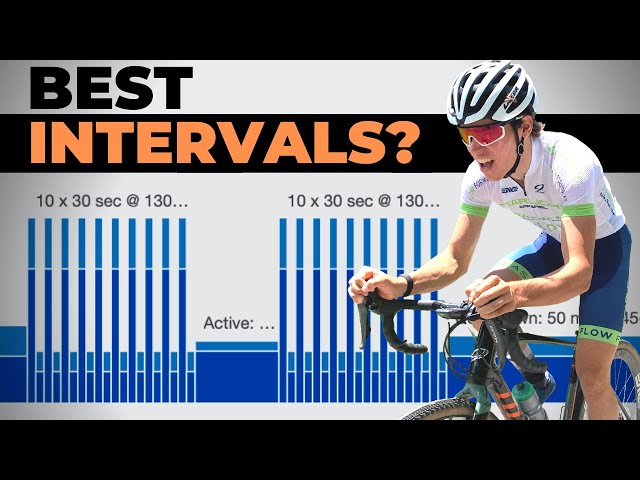
[12:12] I usually organize this workout in a 30-30 configuration so that there is 30 seconds on and 30 seconds of rest.
[12:18] This may be repeated 10 to 15 times depending on your ability level, and the number of sets can be two or three.
[12:24] Let yourself recover for about 10 minutes between sets.
[12:27] Number two is the VO2 max interval. It's called this because you're riding right at your VO2 max intensity.
[12:33] Generally, a good interval duration for these is four minutes.
[12:36] Novice riders may only be able to do four, but pros may be able to knock out as many as eight.
[12:42] How long the rest intervals should be for these depends on your goal, but research indicates that two minutes may be all you need.
[12:48] This study on the impact of restoration on work intensity during interval training had subjects perform six all-out four-minute intervals on a treadmill with one, two, and four minutes of recovery.
[12:59] What they found was that running velocity increased slightly when rest increased from one to two minutes, but showed no further increase with a four-minute rest period.
[13:08] On top of that, when subjects were told to choose how long they wanted to rest between intervals, they chose around two minutes.
[13:15] The reason I say it depends is because if your ultimate goal is to have an insanely high four-minute power, then it's probably good to err on the side of more rest and go with four minutes between intervals.
[13:26] However, if your goal is repeatability, then go with two minutes.
[13:30] The last workout on the list is eight-minute intervals.
[13:33] As we've seen, these seem to be particularly effective and may be easier mentally than four-minute intervals.
[13:39] Generally, I would try to do four of these, but again, more advanced riders may be able to do more.
[13:44] The limit here is probably around six.
[13:47] Same principles apply for the rest period.
[13:49] Longer for maximum power and shorter for repeatability.
[13:53] Generally, two to four minutes is a good rest period for this workout.
[13:56] And of course, remember to get a good warm-up in before you start doing the intervals.
[14:00] Don't just hop on the bike and start swinging.
[14:02] I've got a video on what your warm-up should look like linked down in the description.
[14:06] Also, I didn't talk much in this video about intervals that specifically target your threshold, but if that is of interest to you, I have a video on how to raise your FTP that I linked in the description as well.
[14:16] If you enjoyed this video, be sure to give it a like, subscribe, and share it with your cycling friends.
[14:21] I'll see you in the next one.
[14:22] I'll see you in the next one.
[14:23] I'll see you in the next one.
/ Sources
Sources & further reading
/ WATCH FURTHER